A Reflection on my story 'Fallen Leaves'
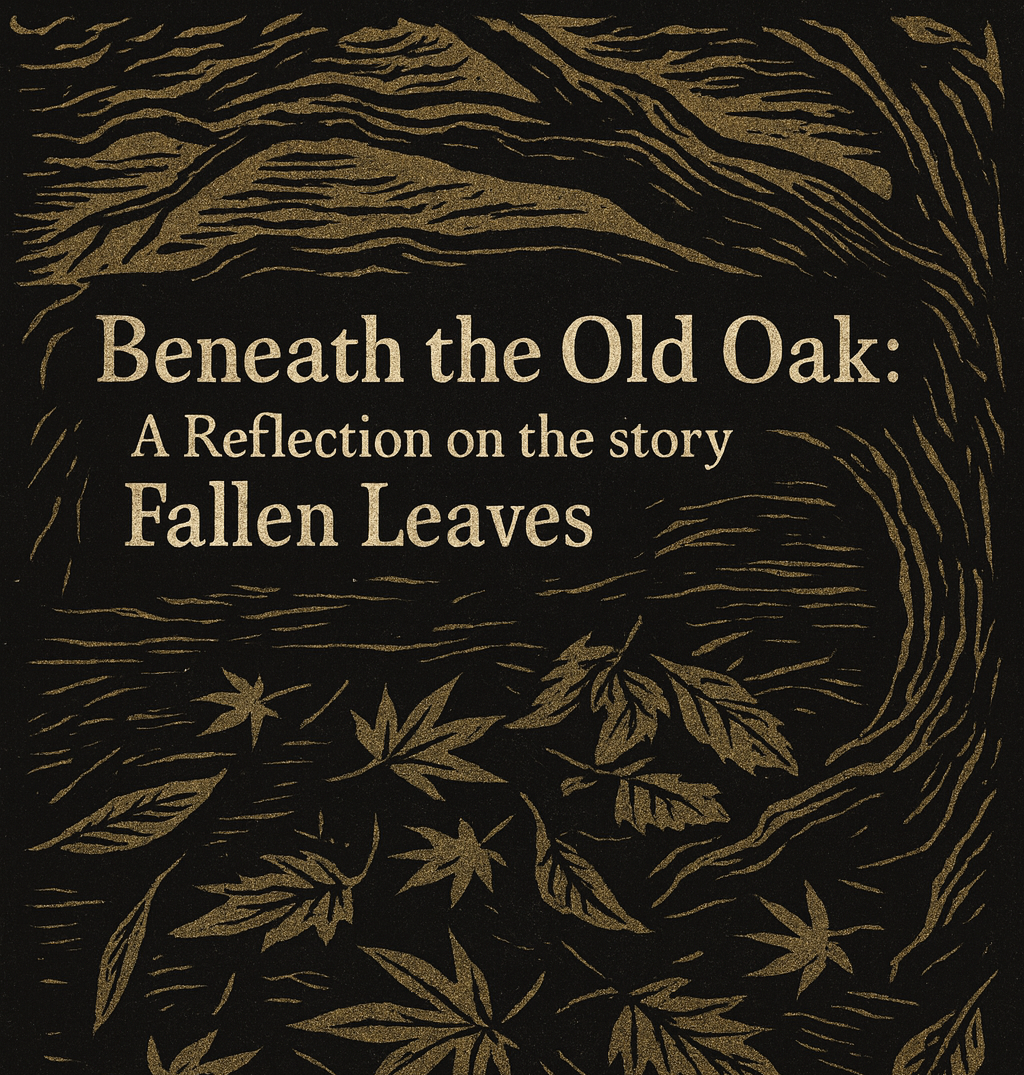
I wanted to share an analysis sent to me by one of my readers on Fallen Leaves, the second - and perhaps one of the key - story in Threads of Shadow. A number of readers have now told me that this is the piece they return to once they’ve finished the whole book, revisiting it to gain a deeper understanding of how it connects to the novel as a whole. Anyway a really Big thanks to Sally Billingham for taking the time to read my book and write this analysis.
The Smiling Face of Evil: On Fallen Leaves
By Sally Billingham
Fallen Leaves is a quietly devastating piece of Gothic horror, one that relies not on shock or spectacle but on atmosphere, implication, and the slow erosion of safety. Set in Edwardian England and narrated by an eleven-year-old girl, the story uses a child’s voice to explore themes of innocence, authority, deception, and the persistence of ancient evil beneath civilised surfaces.
At its heart, the story is about absence. Almost every protection that should keep the narrator safe is removed, one by one. Her mother is dead. Her father is away on church business. Miss Preece, who has become a surrogate maternal figure, vanishes abruptly. Even Ned, the earthy, practical presence who understands the land and its dangers, is temporarily misled and sent away. What remains is a house that looks safe but is no longer so, and an adult who wears respectability like a costume.
The narrator’s voice is one of the story’s greatest strengths. She is observant, articulate, and emotionally intelligent, but still unmistakably a child. Her fear is not melodramatic; it is tentative, rationalised, and often suppressed. She repeatedly tells herself she is “a big girl,” that she should not be afraid, which only emphasises how frightened she truly is. Her attempts to understand events are shaped by limited experience, making moments of horror land more sharply. When she hesitates, when she fails to bang on the window or runs instead of helping Ned, the story does not judge her. It recognises fear for what it is: paralysing, especially in the young.
Uncle Roger is a deeply unsettling antagonist precisely because he is so plausible. He does not arrive as a monster, but as a well-dressed, smiling missionary uncle. His authority is rooted in confidence, religious language, and adult composure. He lies easily and convincingly, reframing reality until even the reader momentarily wonders whether the child might be mistaken. His attempt to present her as mentally unwell is particularly chilling, echoing real historical abuses of power, where children, especially girls, were silenced by claims of hysteria or delusion.
What makes him truly frightening is that he operates on two levels at once. He is both a human predator and a cultist serving something older and vastly more powerful than himself. His obsession with the oak tree reveals that he has not stumbled upon this evil accidentally; he has sought it out. The rituals beneath the tree parody Christian worship, twisting familiar gestures of prayer into acts of summoning and submission.
The oak tree itself is a potent symbol. Marked by ancient symbols, bound with copper wire, and surrounded by fallen leaves, it represents a pre-Christian, pre-human power that has never truly left the land. The vicarage, built nearby, feels less like a conquest of evil than a fragile attempt at stewardship. When that stewardship falters, the old forces reassert themselves. The leaf-entity - faceless, towering, and made of decay - is not just a monster but a manifestation of cyclical violence and forgotten history returning to claim the present.
Miss Preece’s fate is handled with restraint, which makes it all the more horrifying. Her disappearance is explained away with polite lies and social convention, yet the truth is revealed obliquely, in moonlight, among rags and fallen leaves. The image of her familiar face among the debris is one of the story’s most powerful moments, precisely because it is not lingered over.
Ned, meanwhile, embodies hard-won wisdom and moral clarity. He distrusts Uncle Roger instinctively, understands the danger of the land, and ultimately believes the child without hesitation. His failure is not moral but circumstantial - he trusts when he should not, delays when urgency is needed. His likely death is tragic not because it is graphic, but because it is inevitable once he chooses to protect her.
The ending of Fallen Leaves refuses comfort. There is no rescue, no revelation that arrives in time, no adult authority to intervene. Instead, the story closes with anticipation - a door opening, a child hiding beneath covers, clutching a doll that has listened to every fear without judgement. Molly, the rag doll, becomes the last refuge of innocence when all human protection has failed.
Ultimately, Fallen Leaves is not about defeating evil, but about how easily it enters when safeguards collapse - and how ancient, patient, and hungry it is. It is a story that understands that the most frightening horrors are not those that roar loudly, but those that smile, speak softly, and wait for the moment when no one is watching.