Frau Perchta: The Terrifying Christmas Witch of Alpine Folklore
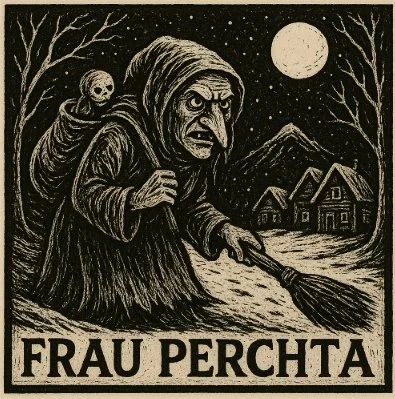
Frau Perchta - roams the snowy countryside.
As winter settles in the high places of Bavaria, Austria, and Slovenia, snow tumbles from the sky, turning once-green mountain valleys into icy wonderlands. Cold northerly winds force the people of these regions to spend more time shut inside their homes, fires banked high to drive away the seasonal chill. It is a time to sit together by the dim, flickering flames, a time for stories, for old legends, and for whispered warnings of the dreaded Frau Pertcha.
Pertcha, or Berchta, was thought to be a pagan goddess worshipped throughout the Alpine regions. Her name is believed to mean ‘the Bright One’, though there are several interpretations. Perchta is sometimes linked with the Germanic goddess Holda, and acted as a guardian of beasts. She was said to appear during the Zwölften - the twelve days of Christmas - usually on Perchtennacht, on 5th January (Perchten Eve), before Perchtentag (the Day of Perchten), which falls during the Rauhnächte (‘Rough Nights’) the dark midwinter period, between Christmas and Epiphany, when it was believed spirits roamed freely.

Perchta is often described as having two forms. She may appear as a beautiful maiden, white as snow, a caring spirit of nature who spreads her beneficence throughout the land. Yet she also possesses another, far more dreadful aspect - that of Frau Pertcha herself. In this guise she is elderly and haggard, and when she appears so, she must be avoided at all costs.
Frau Pertcha is said to have one unnaturally large foot, sometimes described as that of a goose or swan, perhaps symbolising her ability to shapeshift into animal form. Her face is deeply wrinkled, her nose long and hooked, and her garments are always old, tattered, and torn.
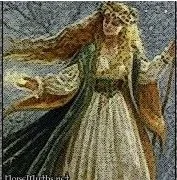
Petcha - the goddess.
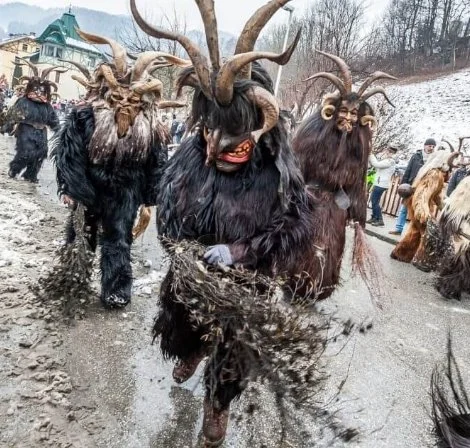
This octogenarian menace roamed the countryside during the festive period, though she did not do so alone. She was often depicted at the head of a Wild Hunt, leading a host of demonic entities collectively known as the Perchten. These beings bore horned, animalistic features, thick fur, hooves, and clanking chains and bells.
She would enter the homes she encountered while her demonic host frolicked outside in the snow. Frau Pertcha could tell which children had behaved badly, but they were not her only concern. She was particularly keen to seek out young women, ensuring they had diligently kept up with their wool-spinning duties.
The virtuous were rewarded with coins hidden in items of clothing, but woe betide those who fell short of her exacting standards, for a terrible punishment awaited them.
She was said to cut open the bellies of these poor souls, remove their entrails, and stuff the hollow cavity with straw and stones - a punishment that earned her the grim title of Belly Slitter. For this reason, she was also known as the Christmas Witch. It was further believed that she would inflict the same fate upon anyone who dared eat anything other than her traditional meal of fish and gruel on her feast night.
A cult of Pertcha eventually arose, its followers leaving food and drink for her in the hope of gaining wealth and prosperity, though such practices were strongly condemned by the Church.
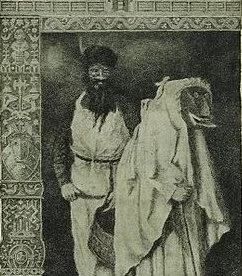
Perchten parades are an ancient pagan custom, likely dating back to pre-Christian times. The first recorded accounts, however, appear in the 16th century. These parades were usually - though not always - led by Perchta, either in her guise as a beautiful woman in white or as a hideous crone. She would be followed by people dressed as her Perchten: some as Schiachperchten (‘ugly Perchten’), wearing fearsome masks with fangs and tusks, clothed in furs and horse tails to drive out demons and ghosts; others as Schönperchten (‘beautiful Perchten’), the fairest members of the community, clad in bright clothing and tasked with bestowing blessings of good fortune and prosperity. Together, they paraded through winter streets before crowds of locals wrapped up against the cold.
So it is wise to have your spinning finished and your behaviour beyond reproach come Perchtentag Eve. The consequences of failing to do so could be both dire - and messy.
Thank you for taking the time to read my blog. I hope this little piece of Christmas folklore has given you a pleasing shudder. If you enjoy what I do, please consider picking up a copy of my new book, Threads of Shadow - link below.
Alternatively, there are plenty of free written and audio stories by yours truly available in the downloads section of this website.
Until next week — stay spooky.
Sources
AtlasObscura. Com
Wikipedia
moonmausoleum.com