Icelandic Folklore – Jólakötturinn, the Giant Yule Cat
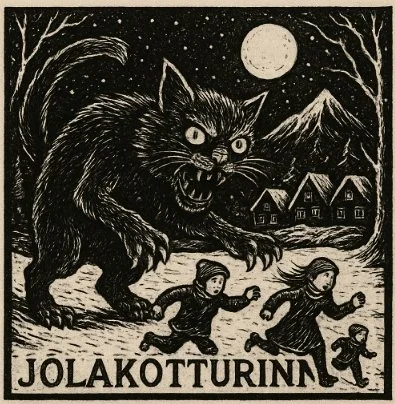
The Yule Cat. Reader feel free in inset your own silly comment with the word Puuurfect in it.
The following Christmas legend was suggested to me last year by my old friend Andrew Fellows. My apologies, Andy, for taking so long to write it.
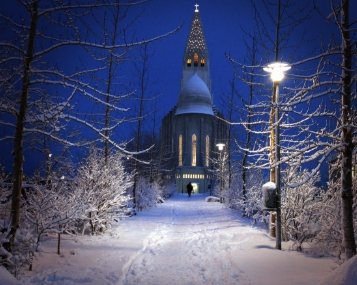
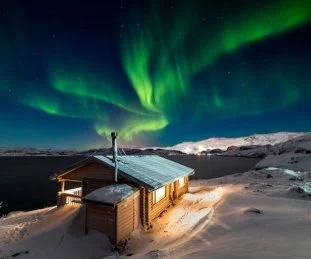
Iceland lies in the freezing ocean between the Arctic and the North Atlantic, described as a land of ice and fire. Its position on the Mid-Atlantic Ridge makes it one of the most volcanically active places on Earth. Lava fields, geysers, hot springs and frequent eruptions shape the landscape; around ten per cent of the country is covered in glaciers, and come winter the land lies beneath a blanket of white snow.
Iceland is therefore a place of great contrasts, rich in terrifying legends and unique Christmas myths. One such tale concerns a monstrous beast said to prowl the winter countryside every Christmastide: a creature of black fur, long of claws and with sharp fangs - the man-eating Jólakötturinn, the Yule Cat.
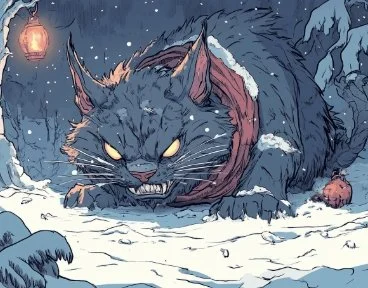
Jólakötturinn, also called Jólaköttur or the Christmas Cat, is believed to be the size of a small house and to possess glowing eyes capable of seeing through the darkest night and the thickest snowstorm. Good luck hiding from this hungry puss. She is considered the pet of the ogress Grýla and her sons, the Yule Lads. I have written a previous post about those thirteen little blighters, and I’ll leave a link to it here, if you want to know more about them. At some point I shall have to tackle the ogress herself - but that’s a story for another day. For now, back to our macabre feline.
The Yule Cat is believed to set forth on Christmas Eve and stalk the land, favouring as prey anyone who has not received new clothes for Christmas - especially children. These festive monsters do seem to enjoy targeting the younger generation.
Threatening the children does makes sense – another way to encourage little Timmy and little Sally to toe the line and behave at a time of year when excitement may tempt them to nail the furniture to the ceiling.
But why target those without new clothes?
This tradition is thought to stem from Iceland’s historic wool industry of the 17th to 19th centuries. Every household needed to complete the autumn shearing, carding, spinning and weaving before Christmas. The tale of the Yule Cat encouraged people, especially farm workers, to finish processing wool before the winter holiday. Anyone who did so would be rewarded with new clothes and therefore safe from the monstrous moggy.
In this way, the Yule Cat can be seen to represent Iceland’s harsh winter, a time when owning proper clothing was essential for survival. Scholars have also noted that cats are sacred to the Norse goddess Freya, whose chariot was said to be drawn by two great cats. How much this influenced the Yule Cat is difficult to say, but it is fun to speculate.
The belief in Jólakötturinn is undoubtedly an old one, but it was first recorded in writing in the 19th century when scholars began to collect the oral traditions of Icelandic farmers and labourers. Most notably, Jóhannes úr Kötlum helped popularise the creature in the 20th century with his famous 1932 poem Jólakötturinn. A translation of this poem is included below.
You know the Christmas Cat,
That cat is very large,
We don't know where he came from,
Nor where he has gone.
He opened his eyes widely,
Making both glow,
It was not for cowards,
To look into them.
His hair sharp as needles,
His back was high and bulgy,
And the claws on his hairy paw,
Were not a pretty sight.
Therefore, the women competed,
To rock and sow and spin,
And knitted colourful clothes,
Or one little sock.
For the cat could not come,
And get the little children,
They had to get new clothes,
From the grown-ups.
When Christmas Eve was lighted,
And the cat looked inside,
The children stood straight and red-cheeked,
With their presents.
He waved his strong tail,
He jumped and he scratched and blew,
And was either in the valley,
Or out on the headland.
He walked about, hungry and mean,
In hurtfully cold Christmas snow,
And kindled the hearts with fear,
In every town.
If outside one heard a weak meow,
Then bad luck was sure to happen,
All knew he hunted men,
And didn't want mice.
He followed the poorer people,
Who didn't get any new clothing,
Near Christmas – and struggled and lived,
In poorest conditions.
From them, he took at the same time,
All their Christmas food,
And also ate themselves,
If he could.
Therefore, the women competed,
To rock and sow and spin,
And knitted colourful clothes,
Or one little sock.
Some had got an apron,
And some had got a new shoe,
Or anything that was needful,
But that was enough.
For the cat should eat no-one,
Who got some new piece of clothes,
He hissed with his ugly voice,
And ran away.
If he still exists, I don’t know,
But for nothing would be his trip,
If next Christmas everybody got,
Some new rag.
You may want to keep it in mind,
To help if there is need,
For somewhere there might be children,
Who get nothing at all.
Perhaps looking out for those who suffer,
From lack of plentiful lights,
Will give you a good day,
And a merry Christmas.
Visitors to Iceland’s capital, Reykjavík, may encounter this terrifying cat in the form of statues, decorations and artworks. Just be sure to wear new clothes – Jólakötturinn is said to be sneaky, and what you assume to be a harmless monument to the deadly puss might, in fact, be the real thing. You would not want to meet this feline wearing last year’s knitwear.
Thank you for taking the time to read my blog. I hope this little piece of Christmas folklore has given you a pleasing shudder. If you enjoy what I do, please consider picking up a copy of my new anthology, Pocket Christmas Horror - a collection of seasonal spooky tales from some of the all-time greats, neatly packaged in a pocket-sized edition designed to sit comfortably in your coat or bag. Link below.
Alternatively, there are plenty of free stories, both written and audio, available in the download section of this website.
Until next week – stay spooky.

Sources
Wikipedia
historyextra.com
www.discoveryuk.com
genius.com (translated poem)