The Hag of Beara: Ireland’s Ancient Winter Goddess
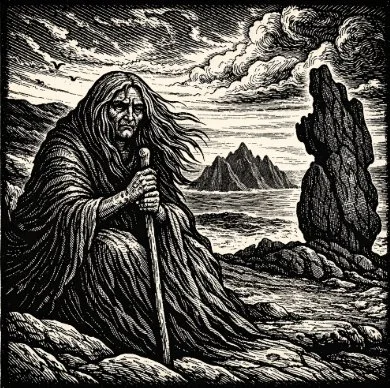
The Hag of Beara… patiently she waits.
If you go far enough south in Ireland you will come to County Cork, here the land eventually begins to break apart.
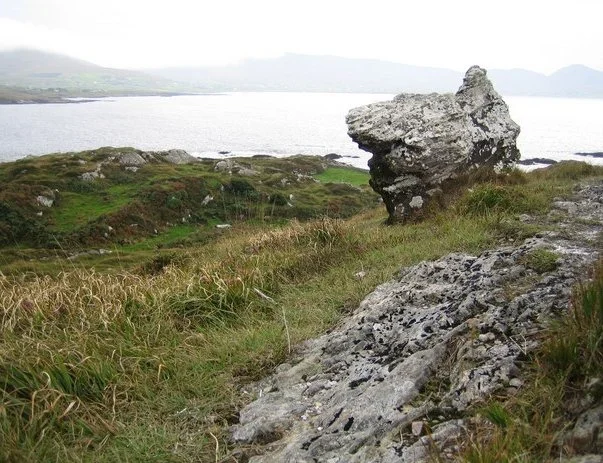
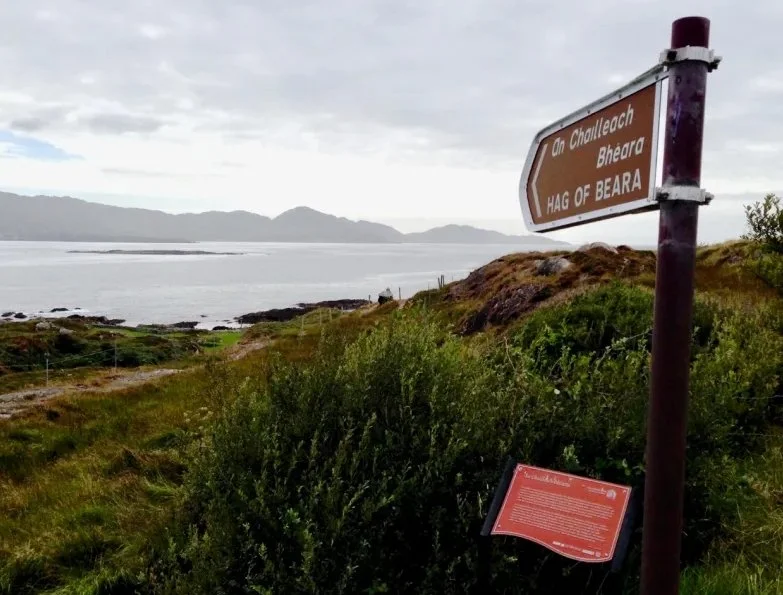
The coastline is torn and folded, bitten into by the Atlantic over countless ages. Long peninsulas reach out into the sea like skeletal fingers - Beara, Sheep’s Head, Mizen - places where the wind never quite rests and the land feels older than memory. It is on the Beara Peninsula, looking straight out into the western ocean, that you’ll find a rough, weathered stone with an unsettling name: the Hag of Beara.
In Irish, she is known as An Chailleach Bhéarra . She is sometimes called the Old Woman of Dingle, or simply the Cailleach (pronounced KAL-yukh VYAR-ra) . In Gaelic folklore, she is no ordinary figure but a divine hag - a being bound to winter, storms, and the shaping of the land itself.
But legend tells that she was not always old.
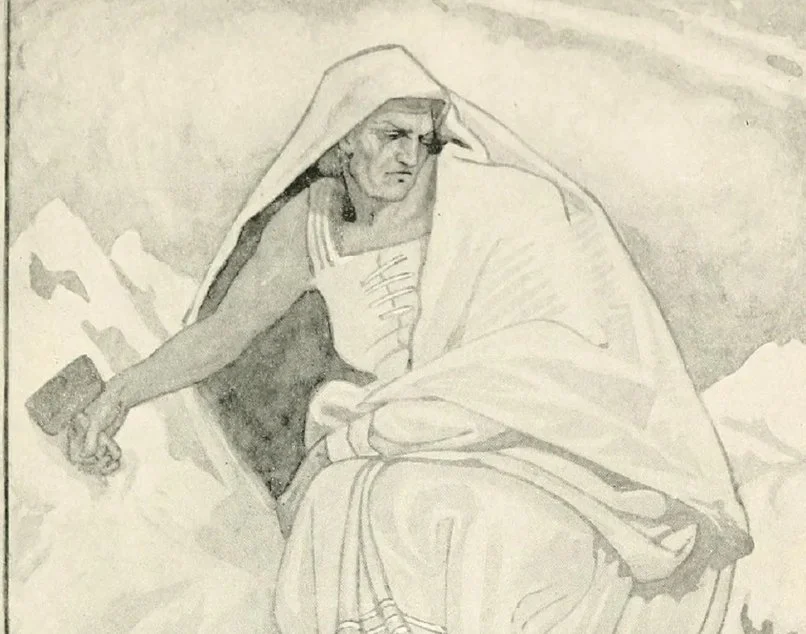
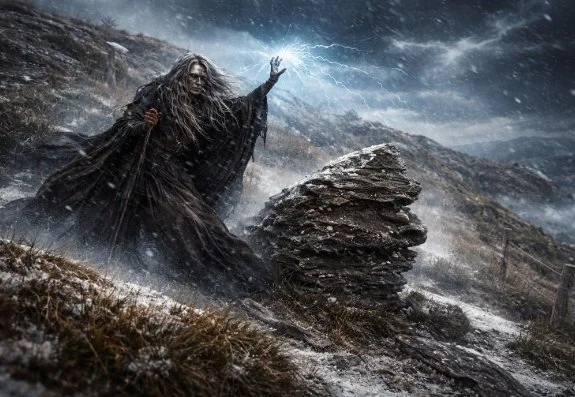
Once, long ago, she was young and radiant - a queen who ruled the land and took many lovers. But the world moves on, and so did she. The earth aged, and she aged with it. As the hills softened and the seas carved deeper into the coast, time wore her down as surely as salt and wind wear stone.
She is said to have lived through seven long lifetimes, outlasting everyone she ever loved.
The most enduring tale places her on the Beara Peninsula, standing at the edge of the land and staring out across the Atlantic. There she waits for her husband, Manannán mac Lir, the god of the sea, who sailed westward and never returned.
She never followed him.
Instead, she stayed - braced against the wind, eyes fixed on the horizon. Years passed. Centuries. Ages. At last, worn down by waiting and weather, she turned to stone, her face still set towards the ocean. That stone, grey and lichen-covered, is said to be all that remains of her now: the Hag of Beara, still watching the sea, still waiting.
Later Christian stories tell it differently.
In those versions, the Hag steals a holy book from Saint Caitiarán. When confronted, she refuses to give it back, and the saint curses her for her defiance, turning her to stone where she stands.
The Hag’s power is strongest in winter. At Samhain - Halloween, when the old year dies and the dark season begins - she is said to walk the land. Frost follows her footsteps. Storms rise at her bidding. People and cattle are driven indoors.
Her reign is assured until Imbolc, on the 1st of February. On that day tradition says if the weather is fine, the Cailleach is out gathering firewood, and winter will linger. If the weather is foul, she is asleep - and winter is nearly done.
This belief lingers on in St Brigid’s Day. This saint is young and beautiful, and when she takes over the land winter loosens its grip. In some stories, Brigid replaces the Cailleach entirely. In others, she is the Cailleach herself, a goddess, renewed and made young again.
The Hag of Beara was once one of the great figures of Irish mythology, and her presence is felt far beyond Cork. Across Ireland, stones, hills, and ancient monuments are linked to her. In County Meath, the Hag’s Chair at the Loughcrew passage tombs is said to be where she sat, looking out over the land she shaped.
So when winter draws in, and the storms batter the coast, remember the old stories. The Cailleach is abroad, freezing the ground and scouring the land - but she never stays forever. Even goddesses must move on in the end.
And when she does, she leaves spring behind her.
Thank you for taking the time to read my blog. If you enjoyed this piece, please consider picking up a copy of my new book, Threads of Shadow available worldwide on Amazon. Search P A Sheldon.
Alternatively, you’ll find plenty of free stories, written by yours truly, available in the download section of this website.
Until next week — stay spooky.
★★★★★
‘Folklore horror at its best’
Amazon Reviewer
Steve Howard
Sources
Wikipedia
theirishplace.com
thegypsythread.org