The Loch Ness Monster: Scotland's Most Enduring Legend
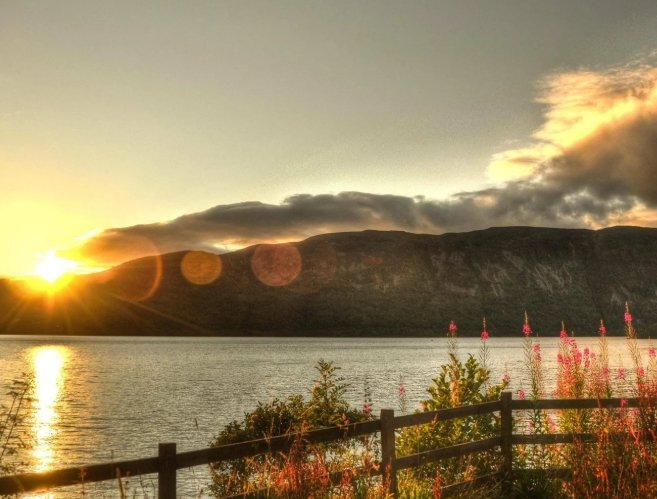
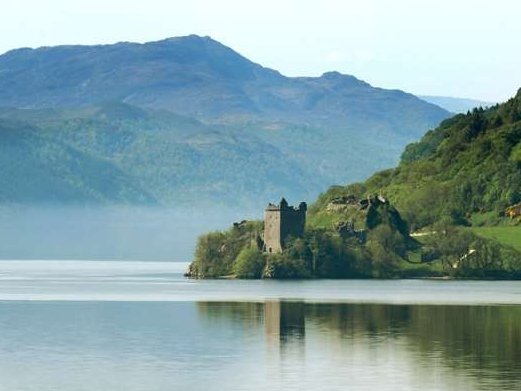
Deep within the Highlands of Scotland, in a wild, legend-shrouded region renowned for its breath taking scenery, lies Britain's largest volume of freshwater.
Loch Ness.
It stretches roughly twenty-three miles in length and contains more water than all the lakes in England and Wales combined. It is home to salmon, brown trout and Arctic char, whilst those with sharp eyes may spot cormorants, ospreys and black-headed gulls soaring overhead. Along its shores roam magnificent red deer stags, red squirrels and pine martens.
Yet another creature is said to call these dark waters home—a beast of enormous size, whose history spans centuries and which has become one of the most famous monsters in the world.
I speak, of course, of the Loch Ness Monster.
The Loch Ness Monster (Scottish Gaelic: Uilebheist Loch Nis), known affectionately as Nessie, first appears in written records dating from the seventh century. The Irish monk Adomnán recounted how St Columba encountered a terrifying creature in the River Ness. According to the account, the beast had already killed one man and attacked another who was attempting to swim across the river. St Columba made the sign of the cross and commanded the beast to go no further and not to harm the swimmer. The creature is said to have retreated immediately, and the unfortunate man was saved.
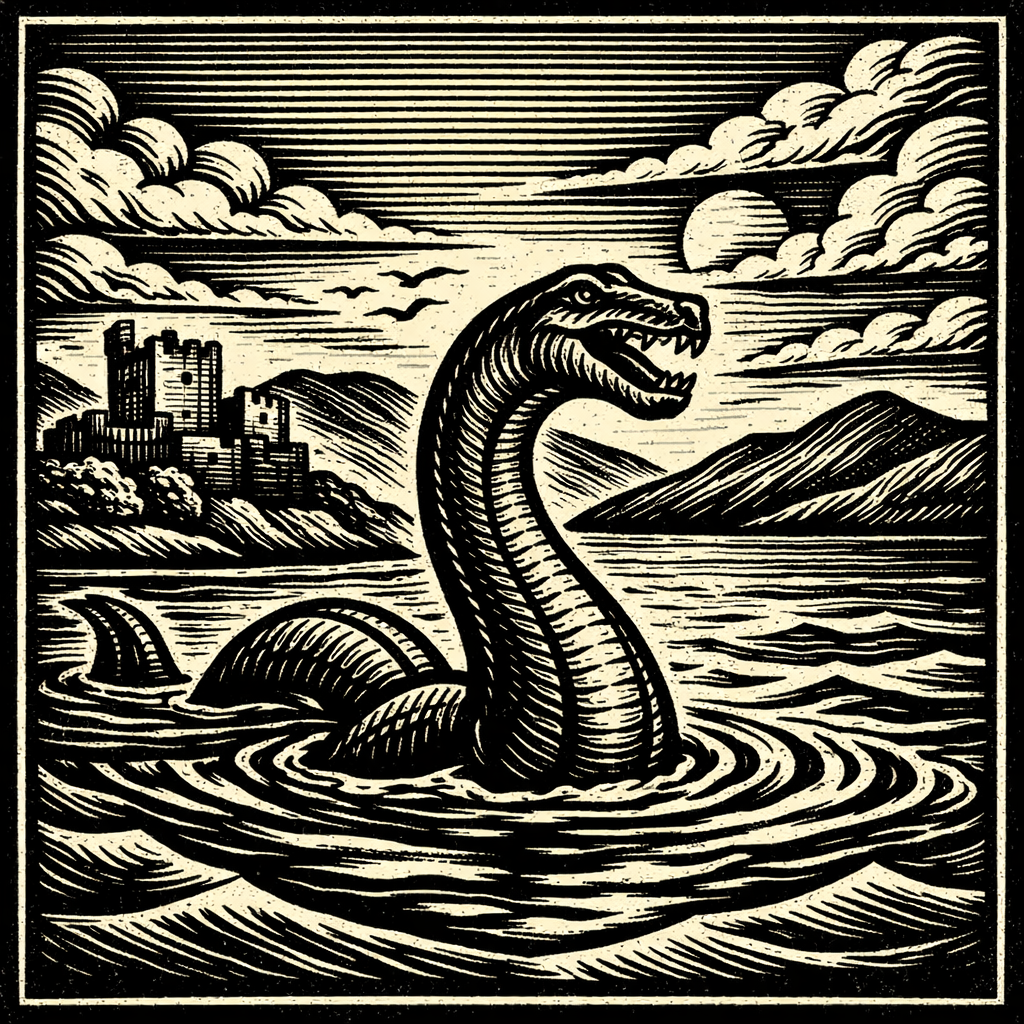
The next notable account did not appear until the nineteenth century, when a gentleman by the name of Mackenzie reported seeing an object resembling an upturned boat wriggling and churning through the water at a steady pace.
Roughly a decade later, Alexander MacDonald claimed to have seen what he described as a large, stubby-legged animal emerge from the loch before coming ashore only a short distance from where he stood. Alarmed by what he had witnessed, he reported the incident to the Loch Ness water bailiff, Alex Campbell, describing the creature as resembling a giant salamander.
It was later in the twentieth century that the same Alex Campbell, who was not only the water bailiff but also a journalist for the Inverness Courier, published an article entitled "A Strange Spectacle in Loch Ness". In it, he described an encounter witnessed by a husband and wife while driving beside the loch.
He wrote:
"The creature disported itself, rolling and plunging for fully a minute, its body resembling that of a whale, and the water cascading and churning like a simmering cauldron. Soon, however, it disappeared in a boiling mass of foam. Both onlookers confessed that there was something uncanny about the whole thing, for they realised that here was no ordinary denizen of the depths, because, apart from its enormous size, the beast, in taking the final plunge, sent out waves that were big enough to have been caused by a passing steamer."
Campbell also noted that there had long been an oral tradition claiming the loch was home to a fearsome beast, suggesting that stories of the creature were already well established amongst local people.
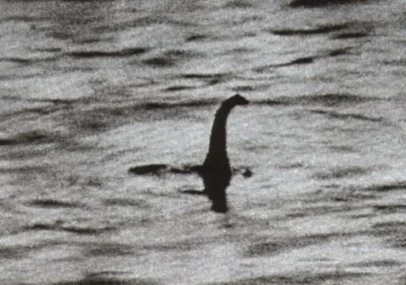
Perhaps the encounter that truly propelled Nessie into the national imagination occurred in 1933, when George Spicer and his wife were driving alongside the loch. They claimed to have seen a strange creature cross the road directly in front of their car. They described it as having a large body with a long, wavy, narrow neck, slightly thicker than an elephant's trunk. Apparently, it was carrying what looked like the body of a small animal in its mouth. They saw no limbs, saying that it lurched across the road towards the loch, leaving a trail of crushed undergrowth in its wake. Spicer later described it as:
"The nearest approach to a dragon or pre-historic animal that I have ever seen in my life."
This was the first widely reported sighting in which the creature was compared to a prehistoric plesiosaur, a marine reptile that became extinct around sixty-six million years ago.
As for this writer, I visited Loch Ness with my wife during our honeymoon in 1999. We took a Nessie-spotting boat trip across the loch, and the skipper showed us a remarkable photograph he had taken a few years earlier. It appeared to show a large grey body breaking the surface of the water. It certainly did not resemble a floating log or a wave, and the image fascinated us.
There have been many more sightings of our aquatic friend over the years, and even as I write this article, new videos continue to emerge claiming to show large, dark shapes moving beneath the surface.
But what are people really seeing?
Over the years, many explanations have been proposed, ranging from deliberate hoaxes to surviving prehistoric animals and even bizarre theories involving interdimensional creatures. Here are a few of the more plausible suggestions.
A Giant Eel
Perhaps the most convincing explanation is the humble European eel. Loch Ness contains a healthy population of these remarkable fish, and some researchers have suggested that unusually large individuals could account for at least some of the sightings. While there is no evidence that eels grow to monstrous proportions, their long, sinuous bodies could certainly create a convincing illusion in the loch's dark waters.
Floating Logs and Seiches
The peat-rich waters of Loch Ness occasionally cause old pine logs to become waterlogged before suddenly rising to the surface. Combined with underwater oscillations known as seiches, which can produce unusual waves even on calm days, these natural phenomena may explain many reports of mysterious humps or moving shapes.
The Greenland Shark
During investigations for River Monsters and in later interviews, presenter Jeremy Wade suggested another intriguing possibility—the Greenland shark (Somniosus microcephalus). This enormous fish can reach over six metres (twenty feet) in length, inhabits cold, deep water and possesses a broad, dark body that could resemble a series of humps when viewed from a distance. Greenland sharks have occasionally been recorded in the waters around northern Scotland.
However, they are marine animals, and there is currently no evidence that they can survive permanently in the freshwater environment of Loch Ness. Although Wade considers the shark an interesting possibility, he does not believe it fully explains the mystery.
Whatever the truth may be, something continues to be seen upon the waters of Loch Ness. Whether these sightings are the product of natural phenomena, mistaken identity, or something genuinely unknown remains one of Scotland's greatest mysteries.
So, should you ever find yourself walking the lonely shores of Loch Ness, keep your eyes fixed upon the dark water... and your wits about you. You never know what may be watching from the depths.
Thank you for taking the time to read my blog. If you enjoy tales of the strange and the unknown, please consider delving into my horror trilogy, The Wendlelow Mysteries. It tells the story of a haunted town and the people—and things—that call it home, unfolding across twenty-seven interconnected stories that reveal both the town's origins and its ultimate fate.
Links to the books can be found in the Shop section of this website.
Until next time, my friend.
Stay Spooky.

Visit the shop section of this website for more information and links.
Sources
Wikipedia
River Monsters – Season 5, Episode 6: "Legend of Loch Ness" (originally aired 27 May 2013).
Whyte, Constance. More Than a Legend. London: Hamish Hamilton, 1957.
Williams, Gareth. A Monstrous Commotion: The Mysteries of Loch Ness. Coffee House Press, 2015.